Notre-Dame-de-Pitié Church


Presentation
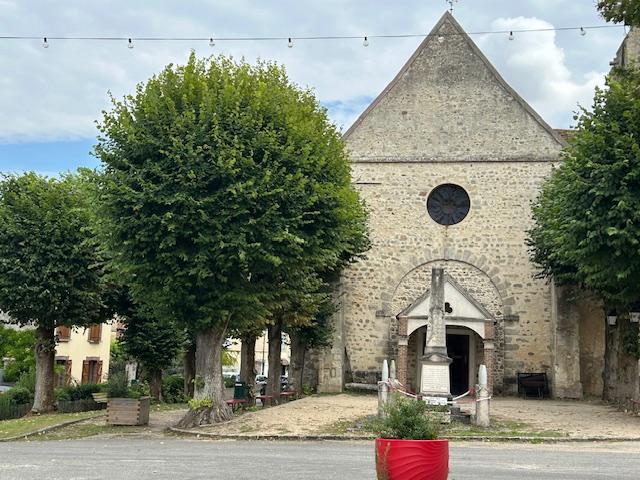
The Church of the Assumption is dedicated to Our Lady of Pity (listed as a Historic Monument on 23 November 1946). It is believed to have been built between 1177 and 1225, during the reign of Louis VII the Young, at the same time as the fortified village.
Only the south façade of the bell tower remains, along with the small turret containing the staircase, which features narrow defensive openings. The nave is thought to have extended beyond the current porch, as suggested by the remains of the ribbed vaulting. The weather vane, shaped like a pig's head and positioned above the church nave, is said to commemorate past plague epidemics.
To the left of the entrance stands a banc des morts, a stone bench on which the deceased was placed before the funeral ceremony.
The west wall, currently unplastered on the inside, reveals the outline of a blocked semicircular arch, within which the main entrance portal is set. Above it is an oculus decorated with stained glass.
The south wall opens onto a small side aisle through several pointed arches.
One of the most striking features upon entering the church is the imposing altarpiece, extended by wooden panelling decorated with seven paintings depicting scenes from the lives of the Virgin Mary, Saint Martha and Saint Vincent (late 17th century). All seven paintings were listed as Historic Monuments in 1977. The altar and carved wooden pulpit, listed in 1944, were crafted by cabinetmaker Grenot in 1786.
In the choir stands a 17th-century gilded wooden eagle lectern in the Louis XIV style (listed on the Supplementary Inventory of Historic Monuments in 1977).
On the south wall of the nave are two statues of the Virgin and Child: one in polychrome stone, of uncertain date but primitive craftsmanship, and the other dating from the 17th century, made of coated and painted wood (both listed in 1977). Further down the nave, in an archway opening onto the side aisle, stands a rather dark polychrome wooden statue of Christ.
In the side aisle is the Chapel of the Virgin, whose altar is dominated by an elaborate Pietà. The entire ensemble was donated around 1837 by Queen Marie-Amélie, wife of King Louis-Philippe.
Free access.
From 01/01 to 31/12/2026, daily.
Equipements :
Car park
Parking nearby
Free car park
Langues parlées :
French
Tourisme adapté :
Doors >=77 cm wide